
Desertcart purchases this item on your behalf and handles shipping, customs, and support to Maldives.
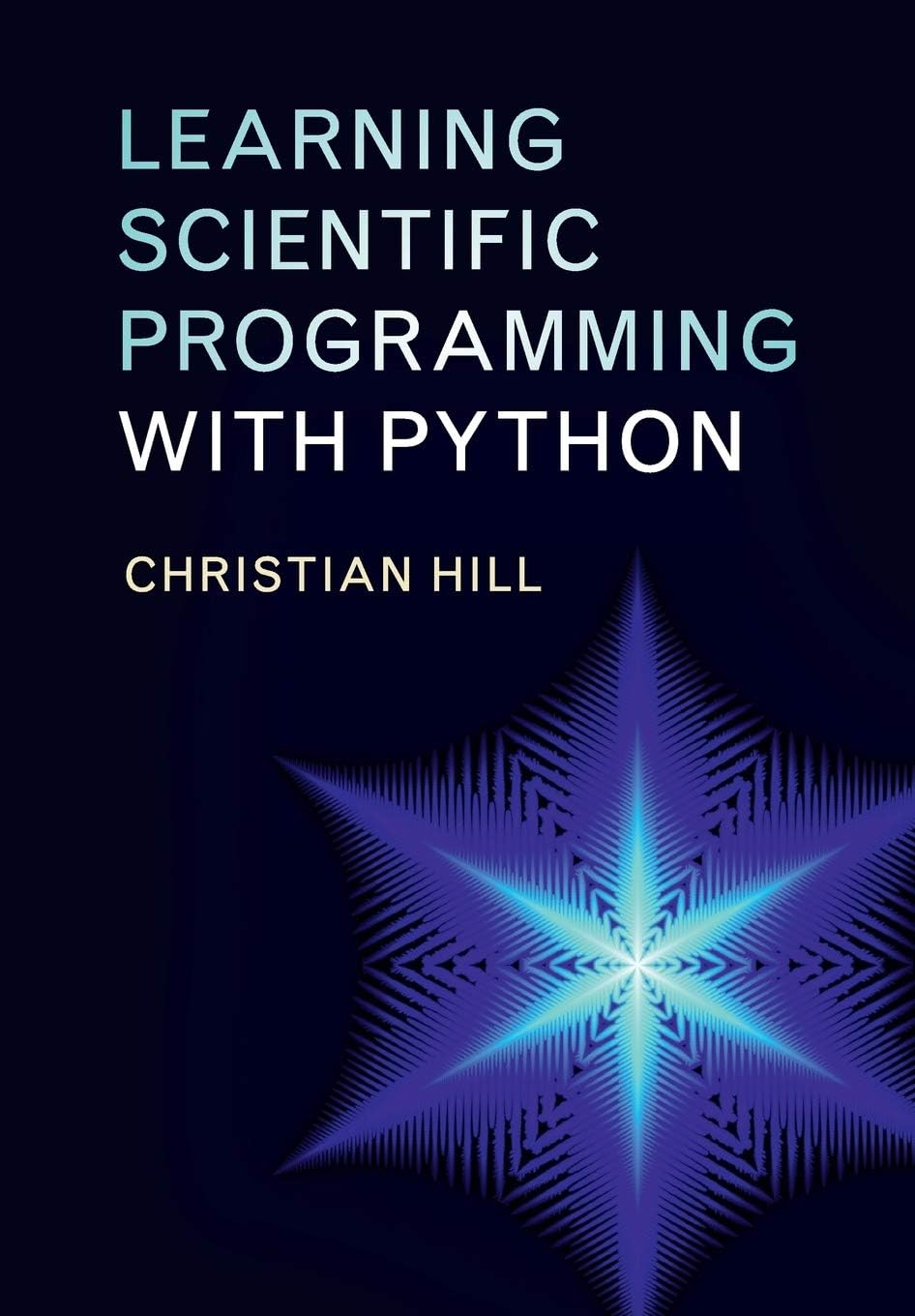
Learn to master basic programming tasks from scratch with real-life scientifically relevant examples and solutions drawn from both science and engineering. Students and researchers at all levels are increasingly turning to the powerful Python programming language as an alternative to commercial packages and this fast-paced introduction moves from the basics to advanced concepts in one complete volume, enabling readers to quickly gain proficiency. Beginning with general programming concepts such as loops and functions within the core Python 3 language, and moving onto the NumPy, SciPy and Matplotlib libraries for numerical programming and data visualisation, this textbook also discusses the use of IPython notebooks to build rich-media, shareable documents for scientific analysis. Including a final chapter introducing challenging topics such as floating-point precision and algorithm stability, and with extensive online resources to support advanced study, this textbook represents a targeted package for students requiring a solid foundation in Python programming. Review: An excellent resource for learning and working with Python written by a scientist for scientists. - About 9 months ago, I had signed on to do undergraduate research in astronomy which my professor told me was going to be "heavily Python based". I had NO previous programming experience. Perusing desertcart for some Python resources, I came across this book which, upon reading the back cover, was written by a physicist, so I thought this would be a good fit for me (I'm a physics major) -- and I wasn't wrong. In the first few chapters, Hill will teach you the essentials of the Python language, including a little interlude about making plots with Pylab in Chapter 3. Throughout the rest of the book, you will learn how to use a few Python libraries which are instrumental in science work like Numpy, Matplotlib, and SciPy. In each of these chapters there are plenty of examples with all the code needed to try them for yourself. Appendix A contains solutions for the exercises at the end of the chapters (and not just every odd-numbered exercise). One quality-of-life feature that I like about this book is the index which lists page numbers for the methods used in the Python libraries (e.g. fig.addsubplot(), np.genfromtxt(), etc.). In my undergrad astronomy research, I was tasked to write a Python program which could read-in a few thousand astronomical images of a black hole X-ray binary (using the Numpy method np.genfromtxt() which is covered in this book), turn them into data that Python could read, and produce plots using all that data. During one of our observing runs, our campus observatory telescope was malfunctioning (the telescope wasn't tracking properly) and I was tasked to extract specific bits of data contained in the astronomical images (FITS file header), generate plots using that data to help both us and the telescope engineer understand the problem. This book was helpful to me in all of those cases. This book isn't an all-encompassing book on everything one could do with Python, however. (You won't be learning about machine learning and building a neural network in this book, for example). But if you're in the sciences like me, and want to learn Python in the context of science, this would be a useful resource for you as it was to me. Review: Well organized, great examples - While there are many online Python tutorials, this book has two key advantages. First, this book is complete. It is meant to be read from cover to cover. The text, examples, exercises, and problems complement each other and highlight important features which a programmer is likely to use in practice. Unlike a cookbook, which would provide recipes for specific tasks, this book has been thoughtfully designed to teach key principles. Second, the choice of examples, exercises, and problems is outstanding. Many online tutorials provide simple examples to illustrate the syntax. But in this book, the examples solve actual problems which are interesting and useful. At the same time, the examples are neither too long nor so specialized that they would be of interest to only specialized audience. This book is also very reasonably priced.
| Best Sellers Rank | #3,396,871 in Books ( See Top 100 in Books ) #1,084 in Mathematical Physics (Books) #1,637 in Introductory & Beginning Programming #2,165 in Python Programming |
| Customer Reviews | 4.8 out of 5 stars 85 Reviews |
C**S
An excellent resource for learning and working with Python written by a scientist for scientists.
About 9 months ago, I had signed on to do undergraduate research in astronomy which my professor told me was going to be "heavily Python based". I had NO previous programming experience. Perusing Amazon for some Python resources, I came across this book which, upon reading the back cover, was written by a physicist, so I thought this would be a good fit for me (I'm a physics major) -- and I wasn't wrong. In the first few chapters, Hill will teach you the essentials of the Python language, including a little interlude about making plots with Pylab in Chapter 3. Throughout the rest of the book, you will learn how to use a few Python libraries which are instrumental in science work like Numpy, Matplotlib, and SciPy. In each of these chapters there are plenty of examples with all the code needed to try them for yourself. Appendix A contains solutions for the exercises at the end of the chapters (and not just every odd-numbered exercise). One quality-of-life feature that I like about this book is the index which lists page numbers for the methods used in the Python libraries (e.g. fig.addsubplot(), np.genfromtxt(), etc.). In my undergrad astronomy research, I was tasked to write a Python program which could read-in a few thousand astronomical images of a black hole X-ray binary (using the Numpy method np.genfromtxt() which is covered in this book), turn them into data that Python could read, and produce plots using all that data. During one of our observing runs, our campus observatory telescope was malfunctioning (the telescope wasn't tracking properly) and I was tasked to extract specific bits of data contained in the astronomical images (FITS file header), generate plots using that data to help both us and the telescope engineer understand the problem. This book was helpful to me in all of those cases. This book isn't an all-encompassing book on everything one could do with Python, however. (You won't be learning about machine learning and building a neural network in this book, for example). But if you're in the sciences like me, and want to learn Python in the context of science, this would be a useful resource for you as it was to me.
N**G
Well organized, great examples
While there are many online Python tutorials, this book has two key advantages. First, this book is complete. It is meant to be read from cover to cover. The text, examples, exercises, and problems complement each other and highlight important features which a programmer is likely to use in practice. Unlike a cookbook, which would provide recipes for specific tasks, this book has been thoughtfully designed to teach key principles. Second, the choice of examples, exercises, and problems is outstanding. Many online tutorials provide simple examples to illustrate the syntax. But in this book, the examples solve actual problems which are interesting and useful. At the same time, the examples are neither too long nor so specialized that they would be of interest to only specialized audience. This book is also very reasonably priced.
R**L
Learned more in less than a month of casual reading than I did in a semester
This book makes it extremely easy to learn how to use python for scientific programming. I learned how to use python for media manipulation more than a year ago but I haven't used it since so the first 4 chapters of the book were great for getting me up to speed again and showing me new basic functions. The real meat of the book starts at chapter 6. Here I actually learned how to use python for what I wanted it for and this is something I couldn't learn at my university course. I'm a senior in applied computation and mathematics at my university but this book gave me the skills and confidence to translate the mathematics I have learned into programming. I'm looking forward to using this to boost my portfolio.
L**I
Very well written and covers all the relavent subjects.
Buy this version if it isn't a high priority from the profs. It it very well writen and covers all the relavent subjects such as "Plotting with pylab" or "Metplotlib". The latest edition is very expensive.
G**N
One of the best books on Phython for scientists
very enjoyable volume on using Python in scientific applications. Since I am a mathematical physicist with a strong background in programming and applied work I found this book very useful.
N**M
An excellent Book on Python!
This is the most exhaustive book on the application of Python to scientific and engineering computations. The author's exposition is clear. You will not only learn Python but scientific and engineering computation too. The author covers Linear Algebra too.
Y**R
Love it
Love it
A**R
Learning Scientific Programming with Python...
Learning Scientific Programming with Python ...
E**O
Digno de tenerlo en tu colecciรณn
Cabe resaltar que este libro ya lo habรญa hojeado porque estaba disponible en mi biblioteca; sin embargo, fue tan bueno que decidรญ adquirirlo. El libro cubre la parte bรกsica de Python con problemas cortos pero eficaces. Numpy y Matplotlib tambiรฉn son cubiertas de manera eficaz y el conocimiento adquirido te permite aplicar las bibliotecas y escribir cรณdigo elegante debido a que los ejemplos y ejercicios son muy prรกcticos. La parte de Matplotlib cubre los tipos de grรกficas mรกs usadas, si quieres mรกs detalles puedes consultar la guรญa de Matplotlib en internet. Es muy buen libro para tenerlo como referencia si es que ya lo cubriste todo, y para los principiantes en ciencias me parece que es de lo mejor, aunque recomiendo tener conocimiento bรกsico de Python para pasar rรกpidamente a la parte de Numpy, Scipy y Matplotlib.
J**T
A great introduction
'Learning Scientific Programming with Python' is a very well thought-out introduction to Python. It would probably not suit an absolute beginner with zero programming background at all, but that's no surprise: it's often said you learn more from the second book you read on a topic, rather than the first. The chapters are well paced and cover Python from the ground up, with a large number of exercises and more intricate problems. The answers are either in the book or (more likely) on the accompanying website - that has details for both the first and second editions, which is refreshing. The problems take real scientific ideas and are on a range of topics: there is a slight bias toward the author's own background, but this is not really anything to worry about. The approach of mixing core Python skills with those specific to scientific analysis is excellent: the first introduction of pylab means one can start looking at real data within the first 100 pages of the book. I have no hesitation in recommending the book: this will be my go-to in the future.
M**L
Correcto
Usado en muy buen estado
R**R
Expensive but worth the price
Expensive book but excellently written. A must for all scientists working with python.
A**R
Logical flow of content, essential and efficient information for scientific problem solving.
I liked the problem / solution approach.
Trustpilot
3 days ago
1 month ago